From the Kallangur Dental Surgery blog
Retainers Vs Dental Braces In Kallangur

Accredited & compliant


Orthodontic treatment is common in Australia, and plenty of families in Kallangur have a child, a teenager or a parent wearing braces, aligners or a retainer. Crooked, crowded and gappy teeth often become noticeable as the adult teeth come through, and they can also develop in adults as teeth drift over time. Braces and retainers are both part of straightening teeth, but they do different jobs. So how do you know whether you need a dental brace or a retainer? Read on to learn more about retainers vs dental braces in Kallangur.
Why Do You Have To Wear A Retainer Or Brace?
Straight teeth look good, but there is more to it than appearance. Crowded and overlapping teeth are harder to clean, so plaque builds up more easily, which raises the risk of decay and gum disease such as gingivitis and periodontitis. A bite that does not meet properly can also put uneven pressure on some teeth, leading to wear, chips or jaw discomfort. Moving teeth into a better position can make them easier to keep clean and help the bite work more evenly.
Braces Vs Retainers - Which One Do You Need?
The main difference is that braces move teeth, while retainers mostly hold teeth where they are.
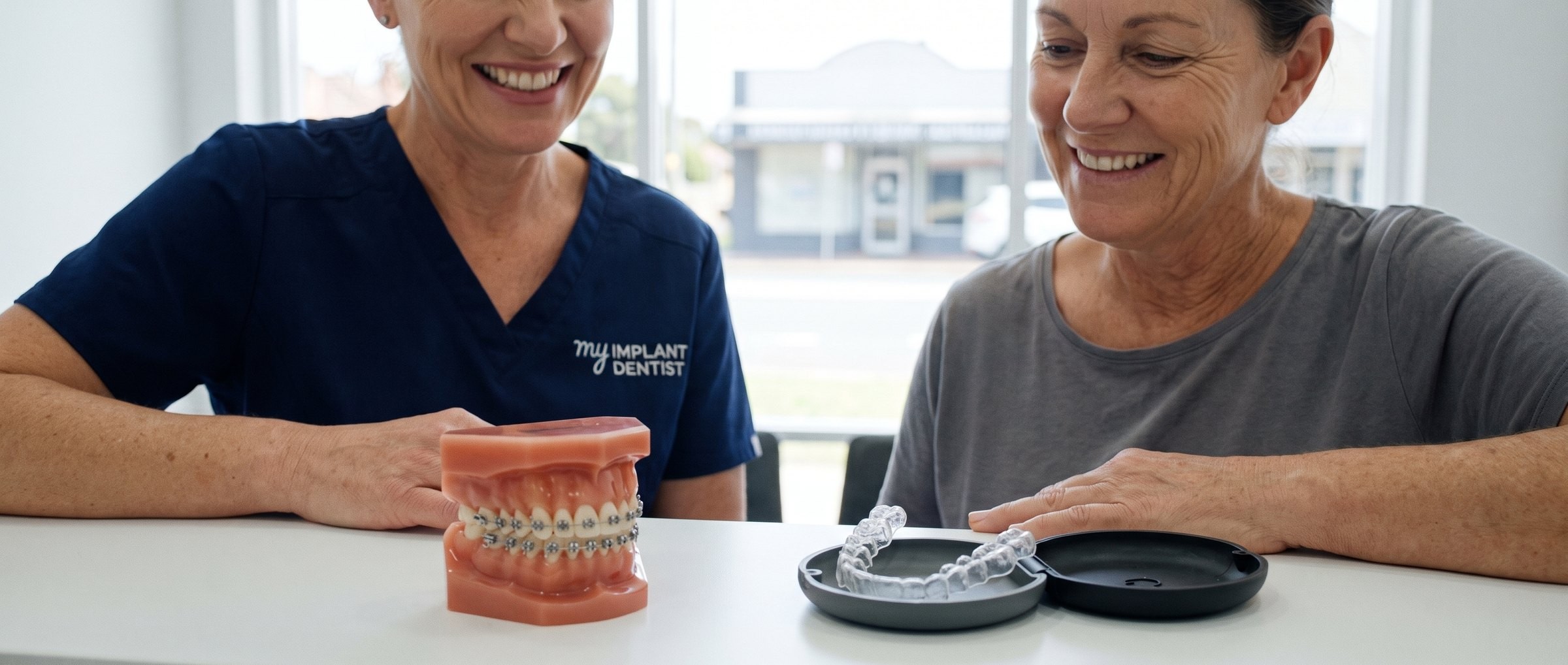
Fixed braces are brackets bonded to the teeth and linked by a wire. They stay on for the whole treatment and are adjusted at review visits. Clear aligners are a removable alternative to braces for many cases: a series of plastic trays that gradually move the teeth and are worn for 20 to 22 hours a day. They are not braces, but they do the same job of moving teeth.
Retainers are custom-made appliances worn after the teeth have been straightened. Some are removable, made of clear plastic or of acrylic and wire, and others are a thin wire bonded behind the front teeth. Their job is to stop the teeth drifting back.
A common misconception is that orthodontic treatment is only for children and teens. Adults can have their teeth straightened at any age, as long as the teeth and gums are healthy. Modern options, such as clear aligners and tooth-coloured ceramic brackets, are much less noticeable than the metal braces many parents remember.
Can Retainers Without Braces Straighten Your Teeth?
Usually, no. A standard retainer is designed to hold teeth still, not to move them. After braces or aligners, the fibres around the teeth take months to adapt to the new position, and the teeth can keep trying to move for years. That is why retainers are worn full-time or every night at first, then usually at night only, often for the long term. Taking a removable retainer out to eat and clean is fine; leaving it out for weeks is how teeth relapse.
There are some exceptions. A removable appliance with small springs or screws, sometimes called an active plate, can make small movements, such as tipping one or two teeth or closing a small gap. These are mainly used for simple problems, often in children, and they work more slowly and less precisely than braces or aligners. If teeth have moved slightly after earlier treatment because a retainer was not worn, a new retainer or a short course of aligners may bring them back. Your dentist will tell you whether this applies to you.
Is It Better To Use A Dental Retainer Or Braces?
It depends on what needs to happen. If teeth need to move, especially several teeth or the bite, braces or clear aligners are the tools for the job. If the teeth are already straight, a retainer is what keeps them that way.
Fixed braces work through small brackets, metal or tooth-coloured ceramic, bonded to each tooth and joined by an archwire. The wire applies steady, gentle pressure, and adjustments at review visits guide the teeth into place. Because braces work on all the teeth at once, they suit crowding, crooked and rotated teeth, and bite problems such as overbites, underbites and crossbites. Some bite problems come from the size or position of the jaws themselves, and these may need specialist orthodontic care.
Clear aligners suit many mild to moderate cases. At Kallangur Dental Surgery, clear aligner treatment starts from $4,500, and every course finishes with a retainer.
Final Note
Ending this note on retainers vs dental braces in Kallangur: braces and aligners move teeth, and retainers keep them in place. They are not interchangeable, and most people who straighten their teeth will use both, one to get the result and the other to keep it. If you are unsure what you or your child needs, or are worried about teeth that have moved after earlier treatment, talk to your dentist in Kallangur.
Get in touch with Kallangur Dental Surgery with any questions you have, or to seek a second opinion.
Book your dental appointment with us online or call us on (07) 3886 0933.
Keep reading
More from our dentists


Your next step
Questions about your own teeth?
Reading is a good start - a check-up is better. Book online in under a minute or call our team on (07) 3886 0933 and we will give you advice specific to your smile.
- New patients always welcome
- All health funds accepted, HICAPS on-site
- Gentle care for nervous patients




 Group