From the Kallangur Dental Surgery blog
Invisalign vs Braces: What’s the Better Choice for Aussie Adults?

Accredited & compliant


If you’re an adult in Kallangur thinking about straightening your teeth, chances are you’re weighing up clear aligners like Invisalign against traditional braces. Both options can deliver good results, but they differ in comfort, appearance, maintenance, and cost, factors that matter even more when you’re balancing work, social life, and family commitments. Below, we break down how each treatment works, what to expect day to day, and how to decide which suits your needs.
How they work
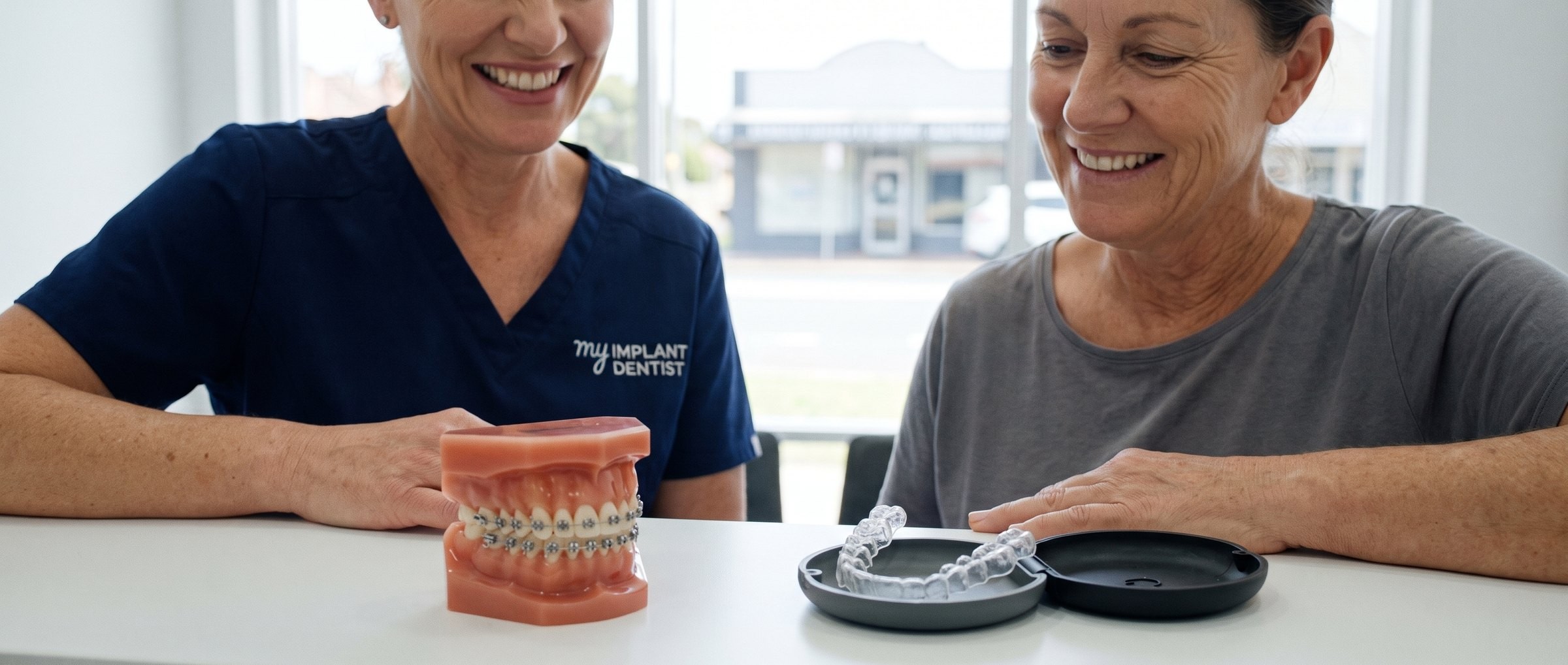
Invisalign (clear aligners): A series of custom-made, near-invisible trays gradually shifts your teeth. You’ll wear them 20 to 22 hours per day, changing to a new set every 1 to 2 weeks. Attachments (small tooth-coloured bumps) and elastics may be used to help complex movements.
Braces (metal/ceramic): Brackets are bonded to teeth and connected by archwires. Your orthodontist or dentist adjusts tension at review appointments to guide teeth into position. Ceramic (tooth-coloured) options are less visible than metal, and lingual braces sit behind the teeth but can cost more.
Aesthetics & lifestyle
Discretion: Clear aligners are the more discreet of the two. Aligners are very discreet in photos and face-to-face, which many professionals prefer. Ceramic braces are subtler than metal but still visible.
Removability: Aligners can be taken out for meals, photos, or big presentations - great for comfort and confidence. The trade-off is self-discipline: if you don’t wear them enough, results slow down. Braces are fixed, so there’s no compliance question, but you’ll need to avoid hard, sticky foods.
Comfort & speech: Many adults find aligners gentler on lips and cheeks. Braces can cause initial rubbing (wax helps). Aligners may cause a short-lived lisp when you start.
Hygiene: Aligners make brushing and flossing simple; just remove, clean teeth, and clean trays. With braces, you’ll need interdental brushes and a bit more time to keep gums healthy and prevent staining.
Complexity & results
Both can achieve good outcomes for the right case. Braces are highly versatile and are often preferred for complex tooth rotations, severe crowding, significant bite corrections, or when very fine control is needed. Clear aligner treatment has advanced considerably and can now handle many moderate cases, and some more complex ones, using attachments, precision cuts, and elastics. Your dentist or orthodontist will assess your bite, bone support, and gum health to advise which treatment predictably meets your goals.
Treatment time & appointments
Typical adult treatment spans 12 to 24 months, depending on complexity and compliance. Aligners often come with more frequent but shorter virtual or in-person check-ins to deliver new trays and track wear time; braces reviews are usually every 6 to 8 weeks for wire changes. If you travel frequently or work FIFO, aligners can be easier to manage with multiple sets issued in advance.
Maintenance, emergencies & diet
Invisalign: Clean trays with cool water and non-abrasive products; avoid hot drinks while they’re in. Lost or cracked aligners can temporarily derail tracking; contact your provider promptly. No food restrictions, but you must brush before reinserting to avoid trapping acids and stains.
Braces: Expect some occasional poking wire or a loose bracket; these are minor but may need a quick visit. Diet is the bigger adjustment: cut down on nuts, hard lollies, sticky toffees, and anything that can bend wires or pop brackets. Electric toothbrushes, floss threaders and water flossers make hygiene far easier.
What does each option cost?
At Kallangur Dental Surgery, clear aligner treatment starts from $4,500. A short course for mild crowding sits near that starting figure, while a case that needs more trays or refinements costs more. You get the exact fee in a written, itemised quote after a free smile consultation, booked with a $75 deposit that is refunded at your appointment or if you cancel with 48 hours' notice.
Braces fees are set by the practice that fits them. As a general Australian guide only, and not a fee of ours, metal braces for a full course are often quoted at around $6,000 to $9,000, with ceramic and lingual braces costing more. When you compare quotes, check whether reviews, refinements and retainers are included, and ask your health fund what your orthodontic extras cover.
Which is better for Kallangur adults?
Choose clear aligners if you prioritise aesthetics, flexibility at mealtimes, simpler hygiene, and you’re confident you’ll wear aligners 20 to 22 hours per day. It’s especially convenient for busy professionals, frequent travellers, and those with mild-to-moderate crowding or spacing.
Choose braces if you have a complex bite, want maximum control with minimal responsibility for daily wear, or your dentist advises that your case suits braces better. Ceramic options strike a balance between visibility and performance.
Ultimately, the right option is the one that predictably achieves your clinical goals within your budget and lifestyle. Ready to explore your options?
Book a consultation with Kallangur Dental Surgery to compare Invisalign and braces for your smile, costs, and timeline so that you can move forward with confidence.
You can book a dental appointment online or call us on (07) 3886 0933.
Keep reading
More from our dentists

Your next step
Questions about your own teeth?
Reading is a good start - a check-up is better. Book online in under a minute or call our team on (07) 3886 0933 and we will give you advice specific to your smile.
- New patients always welcome
- All health funds accepted, HICAPS on-site
- Gentle care for nervous patients




 Group